

Introduction
In this learning blog entry, I am going to present key concepts, theories and models from reading the chapter 5: Recruiting and Selecting Employees from the eight edition (2016) of Managing Human Resources by Gómez-Mejía, Balkin and Cardy. I am going to summarize the key concepts from this chapter that includes Human Resource Supply and Demand, The Hiring Process, Meeting the Challenge of Effective Staffing, Selection and Legal Issues in Staffing. I will also present some of the Challenges met from a case “What it Was Really Like Working as an Abercrombie Model” and two other articles related to this HR process in question.
Human Resource Supply and Demand
Labor Supply means the accessibility of the employees with the right kind of skill sets to meet the organizations labor demand and needs. Whilst labor demand is the amount of workers that the company will need to pursue the future goals. Both areas should be balanced, and this require some forecasting and planning. (Gómez-Mejía. Balkin & Cardy 2016, 178-179.)
HRP, or Human Resource Planning is the process that the organization or firm follows to make sure that they have enough right kind of people with correct skills to reach a certain output and that way deliver a specific level of services/products in the future. Labor demand is often affected by the company’s demand of product or services. Labor supply can come from the internal labor market or from the external labor market. It is important for a firm to forecast possible changes in the labor supply and demand to make sure that they always have enough knowledgeable staff but also not too many considering the company’s needs. HRP can use different kinds of qualitative and quantitative methods to predict labor supply and demand to gain information for action. It is also important to keep the labor market’s attractive to the new and old workers, to maintain the balance in labor supply and demand. (Gómez-Mejía. Balkin & Cardy 2016, 179-183.)
The Hiring Process
In general, all the hiring processes include three actions. First is the Recruitment, Secondly the Selection and thirdly the Orientation by socialization. In the recruitment process the firm opens a job to the markets to attract the right candidates both inside and outside the organization to apply. Then the organization gathers a pool of qualified applicants for a specific job that they want to hire. (Gómez-Mejía. Balkin & Cardy 2016, 183.)
In the selection the firm makes the decision “hire or no hire” considering the candidates for the job. This decision is often based on the impressions, characteristics wanted, interviews or other tests that the applicant may need to do. Lastly In the socialization process the new employee will be oriented to the new job and workplace to make him or her feel like a part of the team. (Gómez-Mejía. Balkin & Cardy 2016, 183.)
Possible Challenges in The Hiring Process
There are many challenges faced in the process of hiring. For example, defining which are the personal traits that are the most important to implement. Also measuring these specific characteristics can often be very challenging. For example, to determine applicant’s certain skill level for a specific task the firm can arrange tests. Then the organization needs to evaluate the candidate’s motivation and ability for the job. These can be quite hard to measure so it is essential to identify some motivational factors in the applicant’s previous experiences for example. On important challenge is to decide who should make hiring decisions in the organization. Often it is best to let the HR department to handle the recruitment process because of the legal requirements and making responsible hiring decisions to avoid possible problems. (Gómez-Mejía. Balkin & Cardy 2016, 183-185.)
Meeting the Challenge of Effective Staffing and Recruitment
The productivity and achieving the goals are the main objectives of the company so it is crucial to choose the right kind of people for the job to maintain progressive effects and a customer satisfaction. Therefore, all the different stages of the hiring process need to be managed carefully and with enough knowledge of the area. The hiring process should focus on attracting enough good applicants both internally, inside the firm, and externally, outside of the firm. It is important to find a right fit for the right job through the recruitment process so that the firm avoids legal problems and rapid changes, turnover, in the staff. The turnovers always have costs for the firm. For example, separation costs, recruitment costs and training costs, meaning that it is more profitable for the company to try to keep their staff happily in the company as long as possible. (Gómez-Mejía. Balkin & Cardy 2016, 184-186.)
Selection
There are many different selection tools that the organization can use in the selection process. For example, letters of recommendation, application forms, personality & ability tests, interviews, psychological tests, assessment centers, drug tests, honesty tests and reference checks. The selection of tools should be reliable and valid because it is most effective and legally defensible. (Gómez-Mejía. Balkin & Cardy 2016, 191-201)
Reliability and validity are important when it comes to these selection tools. Reliability is the consistency of measurement often across time and judges. It is rarely perfectly achieved but it can offer an index of how much error has influenced in the measures. Validity is the level to which a method measures the intended knowledge, skill or ability. It can correspond to actual job performance and can be a very useful tool. Validity can also be concurrent or predictive. Concurrent validity is the level of correspondence between selection and performance counts, when measured at the same time. Predictive validity in the other hand is the extent to which selection scores correspondent with performance when it is measured later in time. (Gómez-Mejía. Balkin & Cardy 2016, 191-201)
Legal Issues in Staffing
- Discrimination Laws
- Civil rights Act of 1964, 1991
- The Age of Discrimination in Employment Act of 1967, 1978
- The Americans with Disabilities Act (ADA) of 1991
- Affirmative Action
- Negligent Hiring
(Gómez-Mejía. Balkin & Cardy 2016, 201-202.)
The Case 1: “What It Was Really Like Working As an Abercrombie Model”
Article “What It Was Really Like Working As an Abercrombie Model” was published 2015 in Huffpost by an Activist and a writer Alicia Cook. In the Article Alicia takes a stand on how an American retail company Abercrombie & Fitch told the press that they would change their heavily sexualized marketing and stop hiring staff based on “body type or physical attractiveness”. Alicia herself used to be a former Brand Representative or “Model” on Abercrombie’s sales staff and tells her point of view what she thinks about it.
She told that in her hiring process there were several Issues and challenges. First of all she was picked form the Mall and called for an interview. However, in the end there was no interview since the Manager just picked the people with the right kind of appearance and did not care about selection tools nor applicant’s backgrounds. For example, the Manager did not know anything about Alicia. She hated retail, was not a people person and had limited availability because of her studies. But the Manager was only interested in her appearance and how she would look like to the customers while working. All in all those characteristics and factors made her a very bad fit for the job and all of these could have a long run impacts on the company’s imago, the customer service and Alicia’s complacency. The manager also changed the official job titles like ”Sales Associate” to non-official one “Model” which had nothing to do to an actual position that was firstly offered. This could easily lead to some legal problems and negligent hiring litigation. (Cook 2015.)
One big problem was also that the actual recruiting process was given to the new staff since they were told to recruit the right looking people from the mall, including minorities every now on then to avoid lawsuits of discrimination. The open position should be opened to the markets and followed by HRP efforts. The recruitment process should be done by HR team who has the knowledge of legal issues and skills to find the right match for the right position.
Article: “The True Business Cost of a Poor Candidate Experience”’
The Article : “The True Business Cost of a Poor Candidate Experience” was published 2019 in Human Resource Executive by Jacqui Maguire. The Article involves topics such as employee recognition, engagement, HR leadership, recruiting and talent acquisition. Jacqui Maguire is director of talent acquisition at Greenhouse.
“An organization is only as strong as its people. With that concept as a guiding principle, hiring should be an intentional and strategic process. But making the right hire can’t be the only goal of a recruiter”(Maguire 2019).
Jacqui addresses that besides the skill to find a right fit for the position, the recruiters should also ensure that the applicants have a positive experience of the process and the company. Why? Because now days it is so easy to share the experience in public platforms like Glassdoor, and a bad review can harmfully effect on the firm’s reputation. Poor Experiences can also in a long run cost money for the company. It can limit firm’s future talent pool and actively discourage people from applying the job. That could force the company to hire less qualified applicants to fill empty roles because the best ones are no longer attracted to work in there. As well as a possible brand damage can lead by extension to hurt sales and revenue. (Maguire 2019.)
Instead the HR teams and hiring managers should focus on to structure the interview processes to have a specific purpose to ensure that they have gathered the right kind of information from the applicants. Also, the key is to communicate with the candidates throughout the process especially with the important decisions and steps. This way they feel informed and included. It is also important to Align the experience with company values so that the applicants have a broader picture of the company and its functions. (Maguire 2019.)
Article: “15 New Recruiting Trends You Should Implement in 2020”
Article “15 New Recruiting Trends You Should Implement in 2020” published 2018 in TalentLyft by Anja Zojceska. In the article Anja lists some recruiting trends that can improve company’s recruitment strategies. When these strategies are well implemented into a firms HR process, they can become very beneficial. The key element that she is highlighting as a change is that the focus is now in the candidates who are treated like customers. (Zojceska 2018.)
Below listed the most important HR Trends for 2020:
- Recruitment Marketing
- Inbound Recruiting
- Employer Branding
- Candidate Experience
- Talent Tools
- Candidate Relationship Management
- Social Recruiting
- Recruitment Automation Tools
- GDPR
- Data-Driven Recruiting & HR Analytics
- Employee Referrals
- Talent Sourcing
- Collaborative hiring
- Structured Interviews
- Strategic Alignment
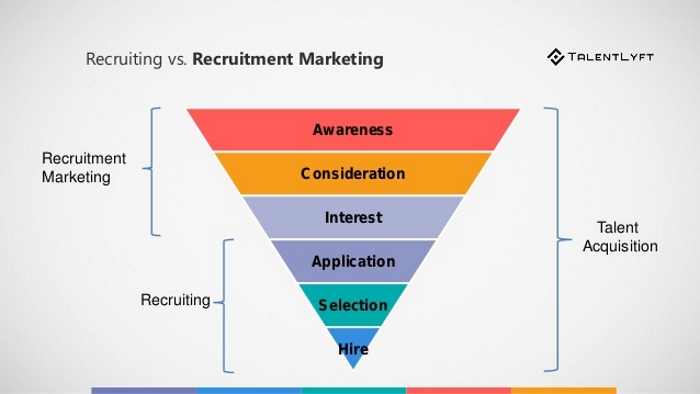
Concluding from this article that in the field of human resource the change is inevitable because of the labor force is getting more international and younger. That is why the recruiters need to keep up with the latest trends to meet the labor markets. (Zojceska 2018.)
Conclusions:
This learning blog gave me a wide perspective included with a multiple details of the topic: Recruitment and Selecting the Employees. I now have more knowledge how the recruitment process works, all of its steps from the start to the finish. It also gave me a perspective not only from the company’s/recruiters point of view but also the candidates. I learned of the challenges and complexity that the HR department and recruitment process needs to take into account to gain the best possible outcome and keep the company profitable and successful.
References
Cook A. 2015. Huffpost. What It Was Really Like Working As an Abercrombie Model. URL: https://www.huffpost.com/entry/what-it-was-really-like-working-as-an-abercrombie-model_b_7154042 Accessed: 28 of January 2020.
Gomez-Mejia, L.R., Balkin, D.B. and Cardy, R.L. 2016. Managing Human Resources. Global Edition 8/E.
Maguire J. 2019. HRExecutive. The True Business Cost of a Poor Candidate Experience. URL: https://hrexecutive.com/the-true-business-cost-of-a-poor-candidate-experience/ Accessed: 29 of January 2020.
Zojceska A. 2018. TalentLytf. 15 New Recruiting Trends You Should Implement in 2020. URL: https://www.talentlyft.com/en/blog/article/87/15-new-recruiting-trends-you-should-implement-in-2020 Accessed: 9 of January 2020.
 pblconblog.video.blog