How can a company adapt successfully in a changing market?

PBL Trigger 4 Problem:

How can a company adapt successfully in a changing market?

Keywords: Mission, vision, strategy, changing markets, adaptation, expand, success, business plan, core competence, worldwide, values, business identity, sacrifice, innovation 

LO1: What is the difference between Mission and Vision in Business?

LO2: How Mission and Vision leads to Strategy?

LO3: What are the Strategies to keep up successfully in a changing market?

Introduction:

On my this blog post I’m going through the topic of our PBL Trigger 4 problem: ” How can a company adapt successfully in a changing market? ” This research also includes three learning objectives enclosed by the same topic. I will start with defining the difference between Mission and Vision in business life. Then in the second learning objective I will find out that how do these lead to company’s strategy. Now I can argue that do they actually lead to the strategy or are they part of that process? Lastly I am going through some examples of strategies that can lead companies to success in a changing markets and adding the conclusions of it.

What is the difference between mission and vision?

These days companies need to have direction in which way to implement the plans to obtain their goals. The vision and mission statements are usually giving this direction to companies. Also, it is good for the employees of the company to have certain cohesive idea how to work together towards the common goals.(Kirkpatrick 2019.)

If the business doesn’t have any of these goals, vision or mission, at some point it will face a lot of problems with employees and finances. That’s why it is important that the company regularly keeps on track with their goals, mission and vision, to inspire, support and develop the employees and whole business to the desired way. For the company to success, they should review the statements actively.(Kirkpatrick 2019.9

The Mission (also can be called action plans, broad strategy) means company’s smaller agenda and mission to ultimately achieve the bigger goal, a vision. (Examples like daily to do’s, targets, changes to be done…)

Mission can include different task or to do’s that all the workers of the organization participates in. It usually is a statement that can be one statement or different ones, but its purpose is to give the workers in the organization a certain framework or idea how to behave and act in that company. It helps the employees to focus on the tasks that can be done right now and give them a present purpose to work on. The mission statement can change, and companies must adapt it to the changing markets to maintain and reach success.(Kirkpatrick 2019.)

Example of Patagonia’s mission statement: ”We are in business to save our home planet. Build the best product, cause no unnecessary harm, Use business to protect nature, Not bound by convention. ”(Patagonia).

The Vision (also known as core values, overall goals) Statement is a clear precise statement of what the company wants to do and what is the ultimate result/affect after accomplishing your mission. It is the ideal achievement that the company wants to reach. The vision is usually future orientated unlike the mission which is focusing on the present.  The idea is that when the company can read their vision statement in present form they will now that it is achieved. Often the organizations can use vision statement in the public purposes, like public relations and marketing. It is important that the company have vision because that will drive it and give a direction for its purposes in a long run.(Kirkpatrick 2019.)

The difference in general is that the mission statement defines what the company is currently doing, or what they need to do to achieve the overall goal. It is giving the employees and other members the guidelines to HOW to achieve the vision. Employees duties, actions and the way they represent the company should include in the mission. The vision in the other hand is giving the idea WHY to the workers; why we are doing the actions we are? It is not very specific and effective way to direct an individual employee actions about the day to day tasks but is does give an overall idea of what the organization want to accomplish.(Kirkpatrick 2019.)

Example of Teach of America’s vision statement: ” One day, all children in this nation will have the opportunity to attain an excellent education.”(TeachForAmerica).

How Mission and Vision leads to Strategy?

Strategy is very much connected to the mission and vision of the company. Strategy could be described as a last step in this ‘process’ that company goes through to achieve the vision. That is why it is crucial for the company to have them both before adding strategic elements to it. When the company is creating the strategy, there can be sometimes additional steps added, like specific objects or targets that they want to reach. These can be used as the base for the overall company strategy.(Miller 2014.)

The organizations strategy should include both long-term and short-term goals and more specifically explain how to achieve the goals that have been set. The company strategy should also be adapted and updated frequently to keep up with the local,- and international economical situations and company’s own needs.(Miller 2014.)

undefined
source of the image:  https://upload.wikimedia.org/wikipedia/commons/0/0e/5_STEPS_STRATGIC_PLAN.png accessed: 30.9.2019

The purpose of the company’s strategy is to successfully align the mission with the vision. It is also important that the strategy with its tactics, tasks and ideas are in line with the company’s values. If all these factors are not working with together it is possible that the strategic plan is more likely to fail.

What are the strategies to keep up successfully in a changing market?

There are numerous business strategies that can be implemented in a different way depending of the field and many other factors. According to Udemy’s article about business strategies that make money there are examples of the business strategies that company can create to attract customers and gain its goals.

Cornering a fledgling market. Which means that the company is buying out their competitors or when a larger company merge with a competitor to corner a young market. For example, Facebook buying Instagram. That lead to competitive advantage over google, Microsoft…(Mikoluk 2014.)

By Product differentiation the companies can stand out with the product from the competitors. Unique qualities, brand, superior technology, styling, price.(Mikoluk 2014).

By Gaining a technological advantage. Due to our vastly developing technological innovations around the world, it is an advantage if a company can claim the latest technology to themselves. This means that often companies are investing a lot of money to different researches or they even buy minor companies just to gain access to their technology and patents. Also, some key employees might come as a technical advantage to some companies.(Mikoluk 2014.)

With Pricing strategies, the companies have option to keep the prices low to attract more customers or pricing the product so high that it is not reachable for all the consumers but giving the product endeavored value  and status. For example, The Swedish furniture brand Ikea bargain for low prices with suppliers and manufacturers, keeping the margins very low and then selling volume instead. The products are more competitive with the lower price and therefor are selling more.(Mikoluk 2014.)

Core competencies are a great tool for companies to use to identify at what they are unique at. How the company stands out from its competitors.

In the Core Competence of the Corporation (1990) it is introduced that the core competence as something that a firm can do well that meets three conditions: It provides consumer benefits, It is not easy for competitors to imitate & It can be leveraged widely to many products and markets.(Prahalad C.K & Hamel G. 1990.)

However now days the definition of core competencies has evolved and expanded. For example, Susan ward  describes the core competencies as:  

”key abilities or strengths that a company has developed that give it a competitive advantage over its peers and contribute to its long-term success.” Core competencies are difficult for competing businesses to duplicate.”(Ward 2018.)

Ward is also arguing that the successful companies often have more than one of these core competencies: quality, customer service, value, innovation and marketing.(Ward 2018.)

Conclusions:

There is more than one answer to a question ”How can a company adapt in a changing market?”. It depends a lot about the company and the field. However, regardless of the differences it can be argued that most of the successful companies have the same basic core elements; strategy, mission and vision. Inside the companies strategies there can be a lot of variability yet still many of the key elements like, customer service and innovation, seem to be always present. Overall the strategies are supported by company’s vision and mission statements and other way around. The implementations of these statements and plans guides and drives the companies to success in the changing markets.

Resources:

Kirkpatrick N. January 11, 2019. Article “The Difference Between Vision and Mission” on betterhelp. https://www.betterhelp.com/advice/general/the-difference-between-vision-and-mission/ .Accessed: 30.09.2019

Mikoluk K. January 7, 2014. Article “Business Strategy Examples: Four Strategies Businesses Use to Make money” on Udemy. https://blog.udemy.com/business-strategy-examples/ .Accessed: 30.09.2019

Miller B. September 9, 2014. Article “Strategy, Mission and Vision: How do they all fit together” on HR Daily Advisor. https://hrdailyadvisor.blr.com/2014/09/09/strategy-mission-and-vision-how-do-they-all-fit-together/ -Accessed: 30.09.2019.

Patagonia, 2019, the company’s mission statement: https://eu.patagonia.com/fi/en/company-info.html Accessed: 30.2019

Prahalad C.K & Hamel G. 1990. In the “the Core Competence of the Corporation” .

Ward S. November 4, 2018. “Core competencies in business” on the balance small business. https://www.thebalancesmb.com/core-competency-in-business-2948314  .Accessed: 30.9.2019

Teach for America, 2019, the organizations vision statement: https://www.teachforamerica.org/what-we-do/who-we-are .Accessed: 30.9.2019

How do the government & the economy affect each other?

PBL Trigger 3 Problem:

How do the government & the economy affect each other?

Keywords: economy, government, corruption, money, laws, regulations, poverty, politics, foreign direct investment, micro-economy, macro-economy, taxes, bureaucracy, economical and social policies, exchange rate. 

LO1: Types of Economies

LO2: Ways Governments controls the Economy

LO3: Pros and Cons of these ways

Introduction:

In this blog post I go through research concerning about the topic of our PBL Trigger 3 problem: ”How do the government & the economy affect each other?” This research also includes three learning objectives enclosed by the same topic. First I go through some most commonly known types of economic systems and then finding in which ways the governments affect to the economies. Then I will go through pros and cons about these ways and ending the research with an overall conclusion.

Types of Economies

There are many economies all around the world that have their unique identities and complexities. However, we have more commonly known four different types of economies. Each of them has its typical characteristics. These are traditional economy, market economy, mixed economy and command economy.

Traditional Economy: Traditional economy is the oldest of the economies and is mainly based on agriculture, hunting and fishing. This economy is valuing the many of the old traditions, ideologies and habits. The supply and demand, products and provided services are mostly connected to the people’s profession and interests. The trade system is often used over money in these economies. The places with the traditional economies are often third- or second world countries with lacking access to the newest technology and advanced medicine yet they tend to have tight community and socially satisfied. (Agarwal 2019.)

Mixed Economy: Mixed economy often combine different economical systems together. In the most common types of mixed economies, optimally markets are not controlled that much by government excluding some areas like transportation or other fundamental industries. However, the government can control problems like equality and monopolies by taxations and other regulations.

Yet the government is usually controlling the regulations of private businesses. The counties often rely on a mixed economy to take the best qualities from different systems of economies. It is argued that most of the countries have a mixed economic system, for example India is.(Agarwal 2019.).

Market Economy: Market economy means that optimally the firms and households can determine how the resources, services and products are given out and produced as well as to who to sell the goods. The government should not be able to intervene and take the profits. In other words, ideally the market economy it is preventing the government becoming too powerful. Yet there never is fully free market economy. In this economy the businesses are effective producers of goods they can put a lot of effort for the researches and innovations and they become highly competitive.(Agarwal 2019.).

Command Economy: Command economy the biggest part of the economy is controlled by the government for example. The government can be responsible for deciding about the supply and demand of the products and resources. They also usually have the ownership of the common services/industries like railroads, aviation and other utilities. The command economies are often focused on the most valuable resources like oil and others. There is hardly no competition in this economy system, so the businesses usually don’t invest resources for the development and new innovations as much.(Agarwal 2019.).

Ways government controls the economy

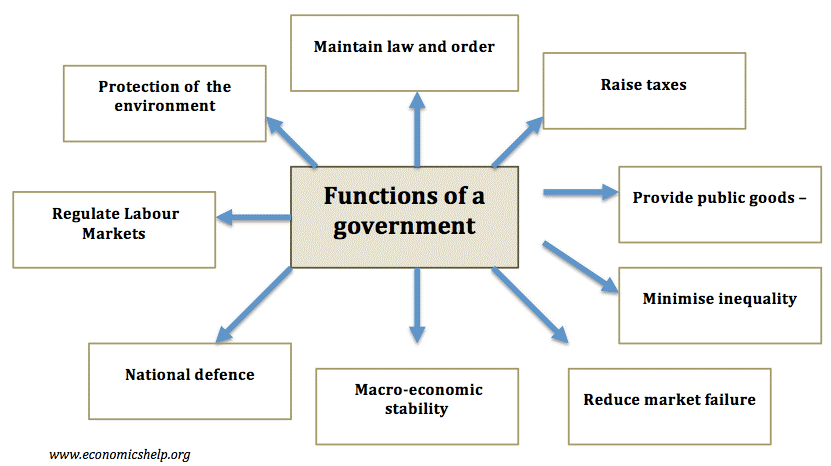
Government can intervene to the economy in many ways. The main object for the governments is to help keep the markets as effective and valuable for the society as possible, offering public services and goods and enforcing markets competition. It also prevents the possible market failures. The customers and producers are often the biggest molders of the economy, the government operations and actions often have a large impact on the economics as well. Usually the government guides the overall functions of the economy to maintain the optimal growth, employability, and the stability of the prices. Some ways are by controlling the money supply, setting regulations, spending and tax rates (fiscal policy), manage the use of credit (monetary policy). All of these can have an impact to the overall economy of the country.(Moffat 2019.)  

Functios of a government by: economicshelp.org

Source:  https://www.economicshelp.org/blog/21699/economics/what-are-the-economic-functions-of-a-government/ Accessed: 23.9.2019

Some other ways the government can intervene to the economies are by regulating the markets, providing fundamental public services, reducing inequality and poverty (by providing education for example) by macro economical management.(Pettinger 2017).

As briefly explained above the macro economical management there are two different policies used by governments. Fiscal and monetary policy:

“Capitalist economies can be subject to economic cycles – economic booms and recession. Recessions can lead to lost output and higher unemployment. In this case, the government may use fiscal policy to influence aggregate demand. The government may also use monetary policy, though, in recent years, many governments have delegated monetary policy to an independent Central Bank. In addition to trying to solve recessions, the government will also try to avoid inflation. This can involve higher taxes and higher interest rates.”.(Pettinger 2017.)

Pros and cons of these ways?

Pros:

There are indisputably many pros when it comes to the ways that governments can control the economies. For example, the government can cut health care costs so that everyone can provide them no matter of what socio-economical class they belong to. They can remove unnecessary laws and bureaucracy to make the markets smoother. By requiring unemployed people to volunteer the unemployment decreases and by them getting involved to society, people can gain skills, contacts and references that will help them be successful in the next job they will encounter. By promoting /supporting economic growth by new innovations and developments the government can create new jobs and fields. This is a huge support for the entrepreneurships for example.(Shapiro 2013.)

“is crucial that we pursue national policies that promote innovation to ensure that there will be enough prosperity to carry on into the next generation”(Shapiro 2013).

Cons:

There are many cons that consider the ways governments may control the economies. These cons can affect to many people living in poverty and make the socio-economical gaps even bigger. The gap between rich and poor expands and causes questions about equal rights.

Cons of the FDI – foreign direct investment considers overseas equity investments by private multinational corporations. The growth of FDI has been extremely fast especially in the developing countries. Recent years these countries have received remarkable amount of all the global FDI flows. A big part of this changing share has been due to a steep fall in investment into developed countries. Yet the data has been shown that the development gap among the developing countries has become greater than ever. The agreements and government policies in developing countries tend to promote the interests of a small number of local factory managers and quite well paid modern-sector workers over the interest of the rest widening wage differentials. These can turn away important recourses from needed food production to the demands of local elite and foreign consumers.(Todaro & Smith 2015, 732-741.)

Conclusions:

Concluding the research, it is clear that this topic in its complexity is changing vastly and it is important to comprehend the basic principles about the types of different economies to understand it’s the multiple affects. The world needs variety in the economics and all of them have their pros and cons. The governments vary all the same, and it would be important for them to find solutions to apply the knowledge and all the available resources we have to the practice and so it would develop the economies more equally in the world. And do it with more transparency at the same time.

Recourses:

Agarwal P. June 3, 2011. “The Four Types Of Economies” https://www.intelligenteconomist.com/types-of-economies/ .Accessed: 23.9.2019

Conte, Christopher and Albert Karr. Outline of the U.S. Economy. Washington, D.C.: U.S. Dept. of State

Moffatt, M. August 22, 2019. ”The Government’s Role in the Economy.” https://www.thoughtco.com/the-governments-role-in-the-economy-1147544 .Accessed: 23.9.2019

Pettinger T. August 3, 2017. “What are the economic functions of a government?”. https://www.economicshelp.org/blog/21699/economics/what-are-the-economic-functions-of-a-government/ .Accessed: 23.9.2019

Shapiro G. January 23, 2013. “Six ways to create Economic growth” on Forbes. https://www.forbes.com/sites/awsmediaandentertainment/2019/09/12/how-to-thrive-in-todays-disrupted-media-markets/#4ad47bfa70ed .Accessed: 23.9.2019

Todaro M. & Smith S. 2015, (732-741). “Economic Development” 12th edition.

What Are The Effects Of Supply And Demand Of Oil Industry?

PBL Trigger 2 Problem:

What are the effects of supply and demand of oil industry?

Keywords: Supply & Demand, Oil industry, Economy, Alternatives, Environment, Elasticity, Unelasticity, Peak demand, renewable sources

LO1: How economies are affected by oil industry?

LO2: Why consumers are not choosing the other alternatives?

LO3: Oil demand is growing, why it isn’t slowing down?

Introduction:

It has been argued that the oil demand will peak because of consumers choosing alternatives such as electric vehicles (EVs), and will no longer need oil. Leading to the scenario that increase in the bio-fuel production will cause the demand of oil permanently decline. Yet the studies show that over the years, oil demand has grown each year and has not been slowing down.(Rapier 2017.) So, the question is why is that, and what are the effects of the supply and demand of the oil industry to the world? In this research blog post I am going through some of the factors from different perspectives to find out effects and reasons that can tell us which direction the oil industry is going.

How economies are affected by oil industry?

Economies are affected by oil industry in many ways. Firstly, it is important to acknowledge that the demand of oil also varies strongly depending of the nation and its developing process.

The oil demand in rapidly developing nations (mostly in Asian countries and India) is much more heightened as demand from developed countries (the OECD countries such as US, Canada Australia, European countries…) when it comes to the in the real price of oil and in oil production.(Aastveit & BjØrnland & Thorsrud 2013, 1.)

This means that different nation’s economies respond differently to unexpected oil markets. Even though economic activity in most of the European countries and the US is permanently reduced following oil supply and oil-specific demand curves, the economic activity in rapidly developing countries decreases less, and can even increase time to time. Some of the still developing countries can be crude material exporters that can benefit from higher terms of trade. And on the other hand, the studies show that countries that are more open and with high investment shares in GDP are usually less negatively affected by higher oil prices.(Aastveit & BjØrnland & Thorsrud 2013, 28-29.)

“Higher energy prices typically lead to an increase in production costs and inflation, thereby reducing overall demand, output and trade in the economy. The market economies have experienced rapid growth in economic activity and international trade, outperforming most developed countries across the world. At the same time, the real oil price has more than doubled, without any apparent severe negative effects on the global economy.”(Aastveit & BjØrnland & Thorsrud 2013, 2.)

Moreover l it is argued that the global oil markets are becoming increasingly competitive, and for major oil producing countries they need to adjust and find new ways to shape their economies for the future. They can no longer rely only on their income from oil since the markets are constantly changing and developing.

Why consumers are not choosing the other alternatives?

Most of the consumers, population, are coming from still developing countries that cannot necessarily afford to the alternatives so easily than in the developed countries. The population of the developing countries is constantly growing, and their economies cannot keep up and support everyone. So even though the more stable countries (OECD) are becoming day by day more efficient with the energy use and choosing alternatives to oil, in a larger scale they are only a minority of the population(consumers) of oil in the markets.(IEA 2018.)

In other words, the more stable countries, economically and growth-wise, are choosing the alternatives and adapting more sustainable lifestyle decisions, such as electric vehicles, mass transits, hybrid vehicles and biofuels. Still despite these adaptions done in a wealthier country the general growth of the population and increased urbanization will keep the oil consumption growing. It is argued that the global demand for oil will likely grow until about 2040 where it is expected to peak up and start to decline.(IEA 2018.)

Oil demand is growing, why it isn’t slowing down?

“Oil demand is growing faster than expected and the world will need more crude from the Organization of Petroleum Exporting Countries, or risk high prices that damage the economic recovery.”.(Herron 2011.)

So, it is all about how fast will the societies and still developing countries meet the basic standards of living for consumers and when they are ready/when it is possible for them to adapt the transformation in technology of electric cars and other alternatives.(IEA 2018.)

Oil consumption is and will be driven by the consumer demand. Therefore, oil demand keeps growing and the markets keeps chancing. Biggest reason for the growing demand is still the fast growth of the population. Especially in the developing countries where the oil consuming is also growing since there is not yet easy to change for the alternatives like biofuel, electric cars and so on.

Resources:

Duey R. Senior Editor for E&P, .Global Refining & Fuels Report; Houston Vol. 15, Iss. 5,  (Mar 8, 2011): 19-21. Report: “Oil Markets Tightening Rapidly to Meet Growing Demand” https://search-proquest-com.ezproxy.haaga-helia.fi/docview/1528076001?accountid=27436 . .Accessed: 16.9.2019

Herron J. Dow Jones Institutional News; New York [New York]18 Jan 2011. ”OECD Oil Demand Still Growing Faster Than Expected-IEA” https://search-proquest-com.ezproxy.haaga-helia.fi/docview/2160144506?accountid=27436 .Accessed 16.9.2019

IEA, Projections from the International Energy Agency, World Energy Outlook 2018 “The gold standard of energy models.” Share talk. “Understand the Future of Global Oil Demand”. Published: 16.5.2018 IEA [IEA, 2018), [World Energy Outlook 2018], All rights reserved. https://www.iea.org/weo2018/ .Accessed: 16.9.2019 https://www.youtube.com/watch?v=iImChz9sUbg .Accessed: 16.9.2019

Knut Are Aastveit, Hilde C. BjØrnland BI and Leif Anders Thorsrud BI. “What drives oil prices? Emerging versus developed economies” CAMA Working Paper February 2013. Centre for Applied Macroeconomic Analysis, Crawford School of Public Policy.

https://cama.crawford.anu.edu.au/sites/default/files/publication/cama_crawford_anu_edu_au/2017-03/11_aastveit_bjornland_thorsrud_2013.pdf Accessed: 16.9.2019

Rapier R. in Forbes. Jun 19, 2017. “The U.S. Accounted for 98% Of Global Oil Production Growth in 2018” https://www.forbes.com/sites/rrapier/2019/06/23/the-u-s-accounted-for-98-of-global-oil-production-growth-in-2018/#2aa9bba05125 .Accessed: 16.9.2019

What leads to employability?

PBL – Trigger 1

Learning Objectives:

  1. What kind of skills and competencies business are looking for?
  2. What teaching methods schools have to offer to meet the business expectations?
  3. How do you keep up your motivation to stand up?

Keywords: 
Experience, Business competencies, Professional identity, Motivation,
Education, Skills

Introduction

In this research I am ultimately looking for answers to our group’s first trigger that is: ”What leads to to employability?”. The question itself led to many sub-questions that we defined as our three learning objectives. (found from above). I think it is easier to try to provide answers to the main problem after diving deeper to this topic with objectives.

This topic is important to current students, educational systems, job-seekers and professionals. The business expectations and labor markets are constantly changing and developing so it is an interesting and challenging task to find out what actually leads to employability, not only now, but in the future as well.

  1. What kind of skills and competencies businesses are looking for?

Since it is hard to predict what kind of job titles there will be in the future it may be easier to focus on the skills and competencies that are required form the individuals and teams in a future business world. Due to an increasing life expectancy, the careers are getting longer, so that worker’s need to get more adaptable to work with different generations and ideologies. Also, that can mean that individuals can increase their employability value by having multiple careers and educations due to a longer careers and self-development time. That can also create more competition in a labor market.(IFTF, Davies A., Fidler D. & Gorbis M 2011, 1-2.)

The research article “Future work skills 2020” mentions six drivers of change that are relevant for reshaping the workforce landscape and defining some of the future work skills. These are such as extreme longevity, rise of smart machines & systems, computational world, new media ecology, super structed organizations and globally connected world.(IFTF & Davies A & al., 2011, 3-5.)

Extreme longevity will affect in a way that the global lifespans are getting longer. Therefore, the people’s careers and educations will change to have more diversity. This can offer the organizations more options and resources to solve problems for example, when future employees have more diversity in backgrounds.(IFTF & Davies A. & al., 2011, 3.)

Rise of smart machines and systems brings more automation to the work places by robots and machines. This can cause humans to be able to focus more on the work tasks that they are good at. For example, some creative or complicated tasks that requires good team work, – and social skills are still skills that humans are uniquely better at than machines. The automatization and working with machines require the adaptability skills from humans to keep up to date with new technological tools in a working space.(IFTF & Davies A. & al., 2011, 3.)

Computational world and new media ecology offer many new technological advantages to the organizations and that means that varies abilities to work and interact with data and new multimedia tech is required. Also, because of the high amount of data available for everyone all the time, people will need to learn to be more critical and observative what comes to the information that can easily change in a day. The new social technologies from different fields can lead to more innovative approaches to create constantly new tools for training and working. This is called as superstructed organizations.(IFTF, Davies A & al., 2011, 4-5.)

In order to companies to grow bigger and more productive it is important for them, and individuals to connect to the world globally. This leads again to more diversity, expanding the perspectives and operations world widely, remaining businesses competitive.(IFTF, Davies A. & al., 2011, 5.)

There are mentioned ten most critical skills in the article. These skills are influenced from the drivers above. These skills are: sense making, social intelligence, novel and adaptive thinking, cross-cultural competency, computational thinking, new media literacy, transdisciplinary, design mindset, cognitive load management and virtual collaboration.(IFTF, Davies A & al., 2011, 8-12.)

Many of these skills above are highlighting the importance of human’s unique features that are not replaceable with machines. Such as higher thinking, emotional skills, collaborative skills, relationship building, novel thinking and so on… Concluding that even though the new technology may provide many tools and automation to organizations there are still variant of tasks that requires individual’s personal skills and are needed to achieve effective results in a business life. (IFTF, Davies A & al., 2011, 3-12.)

2. What teaching methods schools have to offer to meet the business expectations?

In today’s rapidly changing labor markets it can be difficult to keep the education up to date for the business expectations since it can take quite some time for the education systems to change and develop new tools and learning styles. It can be hard to predict what kind of skills and educational background organizations prefer when graduating since some people may take 3 to 6 years to study and then continue to the labor markets. That is why it is important to focus on the school’s point of view on how to provide the right teaching to the students for them later success in a working life.

In A. Puhakka’s research paper about ‘Employability and Finnish University Graduates’ it is argued that which are the most relevant skills that the students may need to learn in schools to meet the working life expectations. Puhakka states: “We analysed different skills usage in connection with the graduates’ current jobs with the help of 16 questions. The most needed skills and forms of knowledge for all graduates were the following: (1) problem-solving skills; (2) teamwork and social skills; (3) communication skills in Finnish; (4) information acquisition skills; and (5) organisation and cooperation skills.”.(Puhakka A. & Rautopuro J. & Tuominen V. 2010, 51.)

It is argued that to become employable for the labor markets the most useful skills taught could be the generic skills such as problem solving, language skills, teamwork and social skills instead of vocationally orientated and too specialized skills. Because of their multiple usage in an everyday business environment. However, Professionals had a slightly better employability compared to generalists. That is why it is important to remember that all kinds of sets of skills can be used in a different context and situations, therefore making different kind of knowledge valuable depending of the situation.(Puhakka A & al. 2010, 52-53.)

3. How do you keep up your motivation to stand up?

Motivation is a key aspect to have when it comes to working towards your goals and thrive to develop yourself. Developing yourself on the other hand can help you to stand out from the crowd. While lacking motivation, it can be difficult to cope even with the things that may seem simple to do, a school assignment or a job task. That’s why a fixed goal is one of the main creators of motivation. A goal can be something that inspires, for example curiosity, in a day to day life even when it is more difficult to find a motivation. Yet a fixed goal can be quite effective motivator because there is an actual goal that you want to achieve. For example, it can be reaching to a certain profession or become wealthy and successful.(Gannon F. 2007, 301.)

In goal setting theory of motivation by Locke, it is argued that there is a difference in the outcome depending on how you set your goals and how they are defined. “Evidence does exist that higher performance results when goals are well defined but challenging, as a successful outcome boosts the self esteem”.(Locke E. & Latham G. 2006, 265-268.)

Conclusions

Concluding the research I think there are many factors that can effect on what leads to employability. These can be combinations of certain skillsets and personal traits of individual when combined with the right employer that values these certain features. Networking, adaptability, right kind of education and experience are all great assets to have. Depending of the labor markets and fields, these might even be necessities that the employers require (because of the high combativeness). Yet it is equally important to constantly self-educate, reflect, be curious and set goals to help to motivate the progress of developing yourself to meet the changing business expectations.

References:

Gannon F. 2007, 301. Motivation. EMBO Reports VOL 8, no 4. European Molecular Biology Organization. https://www.embopress.org/doi/pdf/10.1038/sj.embor.7400949  .Accessed: 9 September 2019

The Institute for the Future (IFTF), Davies A, Fidler D, Gorbis M, 2011. Future Work Skills 2020. IFTF 124 University Avenue, 2nd Floor, Palo Alto, CA 94301 650.854.6322 https://haagahelia.sharepoint.com/sites/globba/coursematerials2/Basic%20Courses/IBU1LF101%20Introduction%20to%20International%20Business/Materials/Main%20Business%20Topics/HRM%20material/future_work_skills_2020.pdf  .Accessed: 9 September 2019.

Locke, Edwin; Gary Latham (2006), ”New Directions in Goal-Setting Theory”, Association for Psychological Science 15 (5): 265-268 https://www.leadership-central.com/goal-setting-theory.html .Accessed: 9 September 2019.

Puhakka A. & Rautopuro J. & Tuominen V. 2010, Employability and Finnish University Graduates. European Educational Research Journal, Volume 9, Number 1, 2010. www.wwwords.eu/EERJ https://haagahelia.sharepoint.com/sites/globba/coursematerials2/Basic%20Courses/IBU1LF101%20Introduction%20to%20International%20Business/Materials/Assignments/Learning%20Diary/Employability%20and%20Finnish%20University%20Graduates%202010.pdf .Accessed: 9 September 2019.

Design a site like this with WordPress.com
Aloitus