
PBL Trigger 3 Problem:
How do the government & the economy affect each other?
Keywords: economy, government, corruption, money, laws, regulations, poverty, politics, foreign direct investment, micro-economy, macro-economy, taxes, bureaucracy, economical and social policies, exchange rate. LO1: Types of Economies
LO2: Ways Governments controls the Economy
LO3: Pros and Cons of these ways
Introduction:
In this blog post I go through research concerning about the topic of our PBL Trigger 3 problem: ”How do the government & the economy affect each other?” This research also includes three learning objectives enclosed by the same topic. First I go through some most commonly known types of economic systems and then finding in which ways the governments affect to the economies. Then I will go through pros and cons about these ways and ending the research with an overall conclusion.
Types of Economies
There are many economies all around the world that have their unique identities and complexities. However, we have more commonly known four different types of economies. Each of them has its typical characteristics. These are traditional economy, market economy, mixed economy and command economy.
Traditional Economy: Traditional economy is the oldest of the economies and is mainly based on agriculture, hunting and fishing. This economy is valuing the many of the old traditions, ideologies and habits. The supply and demand, products and provided services are mostly connected to the people’s profession and interests. The trade system is often used over money in these economies. The places with the traditional economies are often third- or second world countries with lacking access to the newest technology and advanced medicine yet they tend to have tight community and socially satisfied. (Agarwal 2019.)
Mixed Economy: Mixed economy often combine different economical systems together. In the most common types of mixed economies, optimally markets are not controlled that much by government excluding some areas like transportation or other fundamental industries. However, the government can control problems like equality and monopolies by taxations and other regulations.
Yet the government is usually controlling the regulations of private businesses. The counties often rely on a mixed economy to take the best qualities from different systems of economies. It is argued that most of the countries have a mixed economic system, for example India is.(Agarwal 2019.).
Market Economy: Market economy means that optimally the firms and households can determine how the resources, services and products are given out and produced as well as to who to sell the goods. The government should not be able to intervene and take the profits. In other words, ideally the market economy it is preventing the government becoming too powerful. Yet there never is fully free market economy. In this economy the businesses are effective producers of goods they can put a lot of effort for the researches and innovations and they become highly competitive.(Agarwal 2019.).
Command Economy: Command economy the biggest part of the economy is controlled by the government for example. The government can be responsible for deciding about the supply and demand of the products and resources. They also usually have the ownership of the common services/industries like railroads, aviation and other utilities. The command economies are often focused on the most valuable resources like oil and others. There is hardly no competition in this economy system, so the businesses usually don’t invest resources for the development and new innovations as much.(Agarwal 2019.).
Ways government controls the economy
Government can intervene to the economy in many ways. The main object for the governments is to help keep the markets as effective and valuable for the society as possible, offering public services and goods and enforcing markets competition. It also prevents the possible market failures. The customers and producers are often the biggest molders of the economy, the government operations and actions often have a large impact on the economics as well. Usually the government guides the overall functions of the economy to maintain the optimal growth, employability, and the stability of the prices. Some ways are by controlling the money supply, setting regulations, spending and tax rates (fiscal policy), manage the use of credit (monetary policy). All of these can have an impact to the overall economy of the country.(Moffat 2019.)
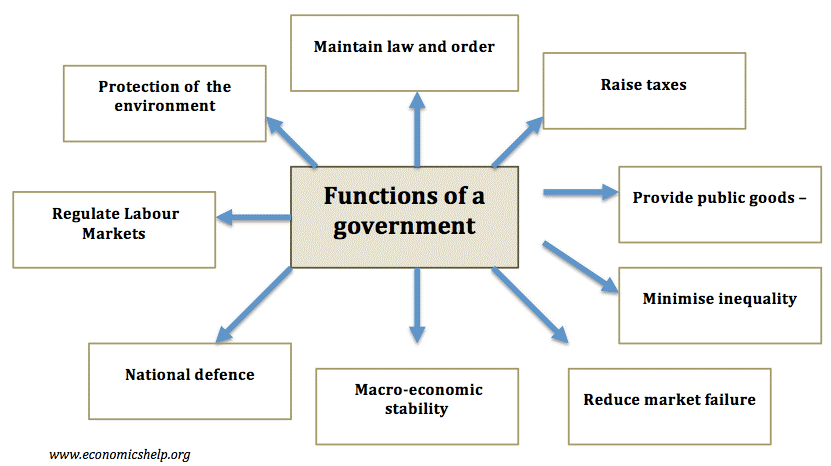
Source: https://www.economicshelp.org/blog/21699/economics/what-are-the-economic-functions-of-a-government/ Accessed: 23.9.2019
Some other ways the government can intervene to the economies are by regulating the markets, providing fundamental public services, reducing inequality and poverty (by providing education for example) by macro economical management.(Pettinger 2017).
As briefly explained above the macro economical management there are two different policies used by governments. Fiscal and monetary policy:
“Capitalist economies can be subject to economic cycles – economic booms and recession. Recessions can lead to lost output and higher unemployment. In this case, the government may use fiscal policy to influence aggregate demand. The government may also use monetary policy, though, in recent years, many governments have delegated monetary policy to an independent Central Bank. In addition to trying to solve recessions, the government will also try to avoid inflation. This can involve higher taxes and higher interest rates.”.(Pettinger 2017.)
Pros and cons of these ways?
Pros:
There are indisputably many pros when it comes to the ways that governments can control the economies. For example, the government can cut health care costs so that everyone can provide them no matter of what socio-economical class they belong to. They can remove unnecessary laws and bureaucracy to make the markets smoother. By requiring unemployed people to volunteer the unemployment decreases and by them getting involved to society, people can gain skills, contacts and references that will help them be successful in the next job they will encounter. By promoting /supporting economic growth by new innovations and developments the government can create new jobs and fields. This is a huge support for the entrepreneurships for example.(Shapiro 2013.)
“is crucial that we pursue national policies that promote innovation to ensure that there will be enough prosperity to carry on into the next generation”(Shapiro 2013).
Cons:
There are many cons that consider the ways governments may control the economies. These cons can affect to many people living in poverty and make the socio-economical gaps even bigger. The gap between rich and poor expands and causes questions about equal rights.
Cons of the FDI – foreign direct investment considers overseas equity investments by private multinational corporations. The growth of FDI has been extremely fast especially in the developing countries. Recent years these countries have received remarkable amount of all the global FDI flows. A big part of this changing share has been due to a steep fall in investment into developed countries. Yet the data has been shown that the development gap among the developing countries has become greater than ever. The agreements and government policies in developing countries tend to promote the interests of a small number of local factory managers and quite well paid modern-sector workers over the interest of the rest widening wage differentials. These can turn away important recourses from needed food production to the demands of local elite and foreign consumers.(Todaro & Smith 2015, 732-741.)
Conclusions:
Concluding the research, it is clear that this topic in its complexity is changing vastly and it is important to comprehend the basic principles about the types of different economies to understand it’s the multiple affects. The world needs variety in the economics and all of them have their pros and cons. The governments vary all the same, and it would be important for them to find solutions to apply the knowledge and all the available resources we have to the practice and so it would develop the economies more equally in the world. And do it with more transparency at the same time.
Agarwal P. June 3, 2011. “The Four Types Of Economies” https://www.intelligenteconomist.com/types-of-economies/ .Accessed: 23.9.2019
Conte, Christopher and Albert Karr. Outline of the U.S. Economy. Washington, D.C.: U.S. Dept. of State
Moffatt, M. August 22, 2019. ”The Government’s Role in the Economy.” https://www.thoughtco.com/the-governments-role-in-the-economy-1147544 .Accessed: 23.9.2019
Pettinger T. August 3, 2017. “What are the economic functions of a government?”. https://www.economicshelp.org/blog/21699/economics/what-are-the-economic-functions-of-a-government/ .Accessed: 23.9.2019
Shapiro G. January 23, 2013. “Six ways to create Economic growth” on Forbes. https://www.forbes.com/sites/awsmediaandentertainment/2019/09/12/how-to-thrive-in-todays-disrupted-media-markets/#4ad47bfa70ed .Accessed: 23.9.2019
Todaro M. & Smith S. 2015, (732-741). “Economic Development” 12th edition.
 pblconblog.video.blog