

Introduction
In this blog entry, I am going to present key concepts, theories and models from the chapters 8 & 9: Training the Workforce and Developing Careers from the eight edition (2016) of Managing Human Resources by Gómez-Mejía, Balkin and Cardy. I will summarize the key concepts from the chapters including the topics such as Training and Development, Challenges in Training and Career Development, Managing the training Process, Meeting the Challenges of effective Development and Self-Development. After that I will shortly present two different articles related to this topic.
Training versus Development
Even though training and development often are associated to go hand in hand the terms are not synonymous. Training is usually focusing on offering employees with specific skills and helping them improve differences in their performance. Training is immediate and can help the employee to fix the current skills to a needed level. Development in the other hand is an attempt to provide employees with the abilities and skills that the organization might need in the future. Development is a long term and focuses on the future needs, preparing the company and employee for the upcoming work demands. (Gómez-Mejía. Balkin & Cardy 2016, 265-266.)
Challenges Met in Training
Some of the key training issues are to make sure that the training keeps pace with a changing organizational environment, where and how it is effectively delivered worldwide. One key aspect is also to deliver the training in the way that the trainees are actually motivated to learn and develop. It is a challenge to keep the content of the training relevant to the performance of the employees jobs. (Gómez-Mejía. Balkin & Cardy 2016, 265.)
There are some factors that the Managers needs to consider of before getting on with the training program. Firstly, is the training the solution to the problem? Secondly, are the goals of training clear and realistic? Third, is the training a good investment for the company? And lastly, Will it actually work? (Gómez-Mejía. Balkin & Cardy 2016, 267-268.)
Managers of the trainees must validate the content and principle of the training so that it has a positive impact on the work performances. Also, training should always be related to organizational goals and needs. (Gómez-Mejía. Balkin & Cardy 2016, 267-268.)
Managing the Training Process
To get the most out of the benefits of training it is essentials that the managers are closely observing the training process. Normally the formal training process contains three different stages. (Gómez-Mejía. Balkin & Cardy 2016, 269.)
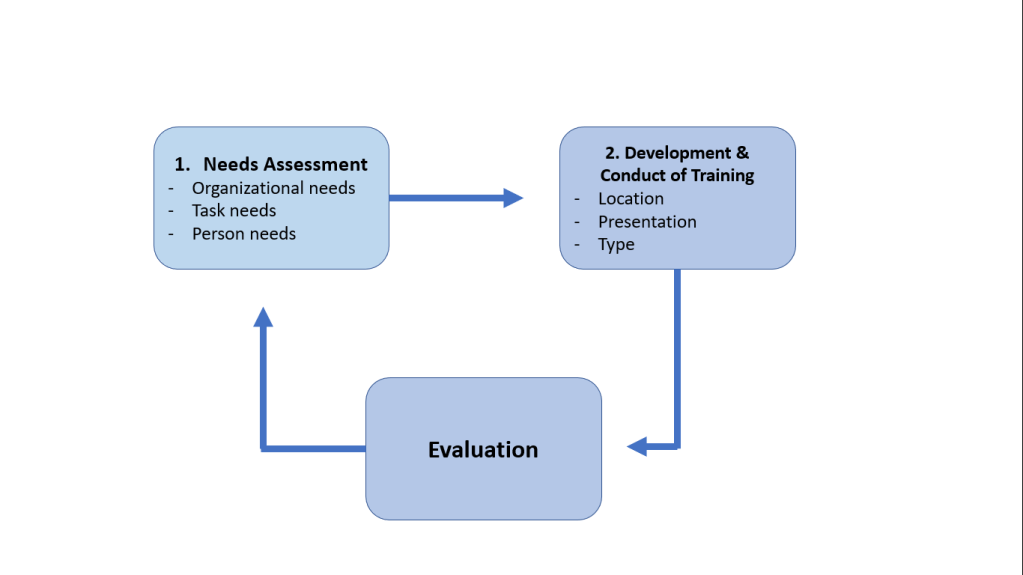
In the Needs Assessment phase it is determined if the training is needed and providing the right information to design the training program. Needs assessment includes three stages of analysis: organizational, task and person. Organizational analysis identifies the overall needs and level of support for training. It addresses the external environment and organization’s goals, mission and values. Task Analysis is assessing the job to be performed and how the training should correlate to it. Person analysis is to determine which employees need the training. (Gómez-Mejía. Balkin & Cardy 2016, 269-270.)
In the Training and Conduct phase the designed training that results from assessment must be a response to an organizational issues or needs. Different training methods vary by Location, Presentation and Type. Training can happen in several locations. For example, in different forms of OJT programs (on the job training) such as job rotation, internships or apprenticeships. There are different kind of methods how to execute the presentation of the training. Slides, videos, teletraining, computers, simulations, classroom instructions and role-plays are some of the common ones used. There are also many different types of training such as skills training, retraining, cross functional training, crisis training, creativity training, diversity training and team-training. (Gómez-Mejía. Balkin & Cardy 2016, 272-279.)
In the Evaluation phase of the training process, the usefulness of the training program is assessed. The effectiveness can be evaluated both monetary or non monetary terms. Finally the training outcome should be measured on how efficiently it delivered the company’s needs it was designed to meet. (Gómez-Mejía. Balkin & Cardy 2016, 281-282.)
”RJP = a Realistic Job Preview is information about the demands of the job, the organizations expectations of the job holder and the work environment (Gómez-Mejía. Balkin & Cardy 2016, 283).
Developing Careers
This chapter provides information how to deal with challenges in developing careers. What is needed for career development programs to be successful, different practices for effective development and competencies in self-development.
Career Development has a wide focus, long time frame and broader scope than a regular training and it is meant to improve the overall performance in the future workforce. It is a constant effort that focuses on developing enhanced and more skilled employees. Development should be one of the key element in business strategies if an organization wants to compete in the markets. Especially due to today’s increasingly competitive global business environment that challenges the organizations surviving. (Gómez-Mejía. Balkin & Cardy 2016, 289-290.)
Challenges in Career Development
While planning a career development program the management must determine who will be responsible for the development. How much weight on development is appropriate and how the development needs of a diverse employees such as dual-career couples. (Gómez-Mejía. Balkin & Cardy 2016, 291.)
Meeting the Challenges of Effective Development
Career development is an important ongoing cycle of three different stages: First comes the Assessment phase, then the Direction phase and lastly the Development phase from which the circle starts over again. Each of these stages is equally important for developing the labor force to meet the future’s demands. (Gómez-Mejía. Balkin & Cardy 2016, 294.)
In the Assessment phase employees skills interests and values are identified. For gathering this information it is useful for the company or employee itself to keep skills inventories. This phase can be processed by the employees themselves or the organization depending of the assessment. Self-assessment can be done through workshops or career manuals for example. The organizational Assessment can be done in assessment centers or via profitability forecasts, succession planning, performance appraisals and psychological testing. (Gómez-Mejía. Balkin & Cardy 2016, 294-297.)
In the Direction phase the career development includes concluding the type of career that employee wants and the steps they must take to achieve it. Employees can receive individual career counseling or information from different sources including a job posting systems, skills inventories, career paths and career resource centers. (Gómez-Mejía. Balkin & Cardy 2016, 298-300.)
In the Development phase the organization may require growth and self-improvement from the employee. It involves actions to create and strengthen skills and competencies to prepare for the future labor demands and opportunities. In this phase it is a lot up to the employee itself to keep their motivation and increase their promotability. There are also common development programs that the organizations may offer to support the employees development. For example, mentoring, coaching, job rotation and tuition assistance programs can be helpful. However, Self-Development is the most important part in which the employee must increasingly take an active approach in their own development and success. (Gómez-Mejía. Balkin & Cardy 2016, 304-305.)
CASE 2 A: Super-sized gamification for training – McDonald’s is lovin it
In the article ”Super-sized gamification for training – McDonald’s is lovin’ it” by Janine Milne shares a point of views how Fast food Chain McDonald’s has implemented 3D virtual reality gamification as an effective training method. Using the methos the future managers can practice their management skills in real time without being afraid of making mistakes. (Milne 2016.)
CASE 2 B: Nando’s tastes success through training: Expanding restaurant firm retains a family feel
In the article ”Nando’s tastes success through training” Expanding restaurant firm retains a family feel. It examines four programmes that have won National Training Awards for Nando’s Restaurants over the last two years. (Emerald Group 2016.)
Despite the rapid growth from 40 restaurants, mainly in and around London in 2001, to more than 100 restaurants across England today, the training has allowed the business to maintain a ”family” feel and remain true to its values. The article also states, that an emphasis on training can go go hand in hand with a high level of employee morale, as the business has lower than average turnover for its industry. This highlights the value of training for all levels of employee. All the way from newly hired restaurant workers – to top management staff. (Emerald Group 2016.)
Article: ”Employee training and development is the biggest HR focus area in 2019”
This article was published by Jingcong Zhao, on January 7, 2019 in PayScale. In the article Zhao explores the reasons of why training and L&D has become an increasing priority for modern organizations, and the challenges associated with training and learning. She also explains some examples of what various companies have implemented to understand the key principles behind successful employee training and L&D initiatives.
As businesses continue to improve their training and L&D programs for three key reasons: ensuring that workers have the skills they need to do today’s work, ensuring that workers have the potential to sustain future business development and keep talented employees on board. And managing a company in today’s global economy has become more complicated. When more businesses are digitalized and activities are automated, the types of skills needed by organizations are changing, with significant consequences for how people pursue their career paths. (Zhao 2019.)
Modern businesses need people who are expert in a number of items. Although technical skills and skills are required, workers increasingly need to tap into soft skills such as critical thinking, innovation and dynamic problem-solving to tackle unforeseen challenges.(Zhao 2019.)
In 2018 LinkedIn’s Workplace and Learning report also found out that talent creators, executives and human resources managers believe that soft skills preparation is the highest priority for talent growth teams. Also, according to the same report from LinkedIn, 94 percent of employees would stay longer at a company if it invested in their career, and 87 percent of millennials say that development is important in a job. (LinkedIn 2018.)
Key Principles behind succesful learning and development programs:
The most important thing to keep in mind is to ensure that your programs are relevant to your organization. Also here are some ideas on how Companies can help their employees get the most of every training and learning opportunity:
- Give people stretch roles/assignments by empowering.
- Cross train employees. Promote from within.
- Provide employees with support on their own terms.
- Let employees know that you are invested in their long-term development.
- Expose employees to outside thinkers.
- Tap into your employee base.
- Involve managers.
- Use technology that employees already like to use.
(Zhao 2019.)
However, it is important to remember that learning does not take place until the basic needs of the employees are met.
It is important to ensure that your compensation package is set up in a way that reflects your priorities as you find innovative ways to help your workers learn new skills and evolve laterally. (Zhao 2019.)
Article ”Where Companies Go Wrong with Learning and Development”
This article was published by Steve Glaveski, on October 2nd, 2019 in Harvard Business review. It argues that in today’s businesses, not only is the majority of training ineffective, but the purpose, timing and content of the training is flawed.
Article explains about the Lean learning, and what it is about:
- Learning the core of what you need to learn
- Applying it to real-world situations immediately
- Receiving immediate feedback and refining your understanding
- Repeating the cycle
It promotes the adaptability that gives companies a competitive edge in today’s market. It’s about learning the basics of what you need to learn, applying it instantly to real-world scenarios, getting immediate input and improving your understanding and continuing the process afterwards. To start implementing lean learning, companies need to switch from measuring earned credits to measuring the generated business outcomes. Lean learning ensures that employees learn not only the right thing at the right time and for the right reasons, but also retain what they are learning. (Glaveski 2019.)
References
Glaveski S. 2019. Harvard Business Review. Where Companies go wrong with learning and development. URL: https://hbr.org/2019/10/where-companies-go-wrong-with-learning-and-development Accessed: 5th of February 2020.
Gomez-Mejia, L.R., Balkin, D.B. and Cardy, R.L. 2016. Managing Human Resources. Global Edition 8/E.
Linkedin 2018. Workplace Learning Report. URL: https://learning.linkedin.com/resources/workplace-learning-report-2018# Accessed: 5th of February 2020.
Milne J. 2016. Diginomica. Super-sized gamification for training – McDonald’s is lovin’ it. URL: https://diginomica.com/super-sized-gamification-for-training-mcdonalds-is-lovin-it Accessed: 5th of February 2020.
Pollitt D. 2006. Emerald insight. Nando’s tastes success through training: Expanding restaurant firm retains a family feel. URL: https://www.emerald.com/insight/content/doi/10.1108/09670730610656879/full/html Accessed: 5th of February 2020
Zhao J. 2019. Pay Scale. Employee training and development is the biggest HR focus area in 2019. URL: https://www.payscale.com/compensation-today/2019/01/employee-training-development Accessed: 5th of February 2020.
Article picture source URL: https://www.needpix.com/photo/1280683/learning-hint-school-subject-background-backdrop-education-learn-information Accessed: 13.2.2020
 pblconblog.video.blog